June 2026 Newsletter
Culture, Ecology and Community in Motion
Warm greetings from Tiapapata Art Centre.
The first six months of 2026 have been full of activities and interesting developments. Our January newsletter opened the year with the theme “Preserving Heritage & Creativity,” with special attention to the continuing legacy of the UNESCO-supported Upu ma Tala – Heritage Talanoa Series and the importance of keeping Samoa’s living heritage active through practice, dialogue, and intergenerational learning.
This second newsletter continues that story. From pottery and paper-making to International Jazz Day, World Museum Day, plant knowledge, visiting artists, volunteers, field research, and new cultural partnerships, the first half of 2026 has reminded us that Tiapapata Art Centre is most alive when people gather here to learn from each other.
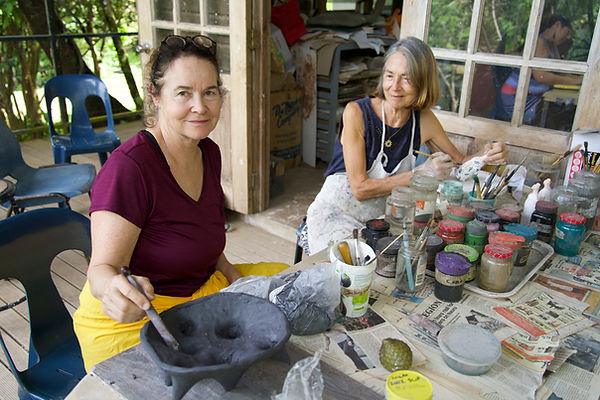
On 2 February, Wendy’s sister Jennifer Bensley-Eskioglou, who is also a potter, moved in for a three-week stay. During her time at Tiapapata, Jennifer explored clay in a playful and intuitive way, producing organic-looking pottery sculptures that responded beautifully to the environment of the Art Centre.
Adam Trybula and Sophie Elizabeth joined us as WWOOFers, staying in the Tiny House from 10 February to 29 March. They contributed to the practical rhythm of the Centre, helping with general tasks, grounds, hospitality, and workshop support.
On 3 February, Ginger Trask, a Fulbright Scholar from California, arrived at the Art Centre. She will be with us until November 2026, conducting research into cultural tourism. As part of her service to the Art Centre, she has also been teaching aerial yoga, adding a new and unexpected dimension to wellbeing and movement at Tiapapata.
Welcoming Artists, Researchers and Volunteers
The year began with a steady flow of artists, researchers, family visitors and volunteers contributing to life at the Centre.
Max Bishop arrived in January and stayed for a couple of months, helping as a general volunteer wherever support was needed. His contribution formed part of the everyday work that keeps the Art Centre moving — from maintenance and set-up to hospitality and practical support.
Wendy with her sister Jennifer Bensley-Eskioglou spent a lot of time together in the Pottery Studio.
We were also delighted to host Denisa and Adam Vilkus, who arrived in November 2025 and stayed until 4 March 2026. Their extended visit allowed them to become part of the life of the Centre over several months.
On 3 June, Ginger Trask, a Fulbright Scholar from California, moved into the Green Room apartment. Ginger will be with us from January to November 2026, conducting research into cultural tourism. As part of her service to the Art Centre, she has also been teaching aerial yoga, adding a new and unexpected dimension to wellbeing and movement at Tiapapata.
Also arriving on 3 June was Lily Walsh, a young artist studying Fine Art at Duncan of Jordanstone College of Art in Scotland. Lily’s research-based practice explores folklore, memory, symbolic markings, and the way stories blur through time and oral transmission. Her interest in Samoa grows from her own curiosity about Scotland’s ancient stones, spirits, and symbolic landscapes, and she hopes to learn more about Samoan folklore during her stay.


Adam and Denisa
Creative Classes, Pottery and Material Experiments
January opened with a burst of creative classes led by visiting artist Kerrie Reyntjes, including pottery classes for children and adults, and a Gelli printing class for adults. These sessions helped set the tone for a year of hands-on creative learning.
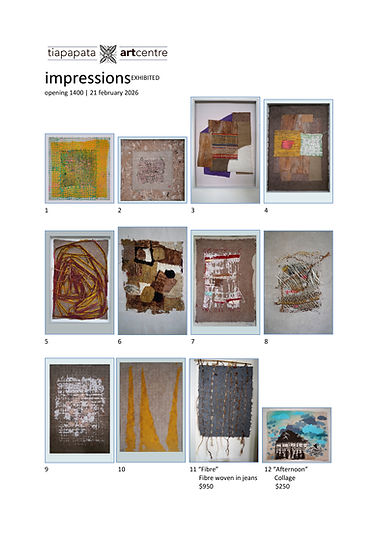
In February, the Centre continued its exploration of clay, fibre, tools, and cultural forms. Wild clay pottery was made and fired in a specially prepared wood-fired kiln, while new crafts were produced including fagufagu, hafted stone adzes, lures, bone carvings, and necklaces made from vegetable ivory. A special exhibition titled IMPRESSIONS opened on 21 February.
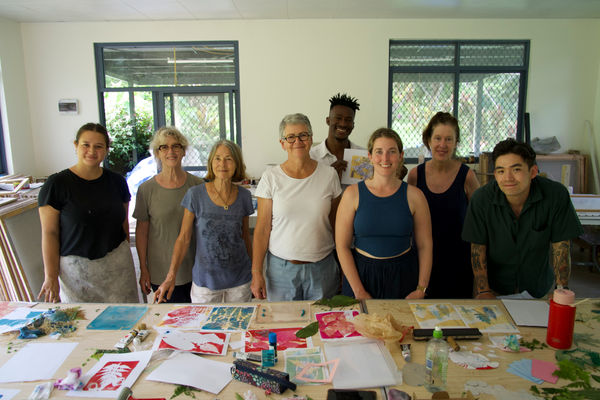
Gelli printing workshop with Kerrie

Firing pottery made with wild local clay

The month also included Discovering Tagaloa, an evening of storytelling theatre, music and reflection featuring spoken word and musical artist Fa‘alafitele Rev. Falefatu Enari. The programme celebrated culture, honoured ancestors, and reflected on historical journeys, including references to Lauaki and his relationship with German Administrator Governor Solf.
On 27 February, special necklaces known as ula nifo were made from vegetable ivory, using wild turmeric and the red sap of the o‘a tree to create yellow and red hues. The following day, Lapita-style pottery was fired in an umu alongside traditional food, connecting contemporary making with Samoa’s deep ceramic past.
In April, material experimentation continued. Branches of fau were tied into bundles and submerged in the sea at Moata‘a, weighted down with concrete, as part of ongoing experiments in fibre preparation. Cow dung paper was also made for the first time, blending cow dung with banana stem fibres to produce a dark green textured paper with flecks of shiny silica.


Submerging fau to faciliate the stripping away of the bark and bast
Siapo, Paper, Clay and the Revival of Living Materials
One of the continuing themes at Tiapapata is the exploration of natural materials — not simply as raw resources, but as carriers of cultural knowledge.
On 29 April, a siapo-making workshop was conducted with visiting artist-in-residence Laura DeAngelis, led by master maker Makulata Taua from Siutu, Sala‘ilua, Savai‘i.
In May, the focus returned to clay and firing. A pottery workshop was conducted by visiting Artists-in-Residence Caitlin Moloney and Matt Sephton, followed by successful firing of Lapita-style pottery in a wood-fired kiln. These experiments continue the Centre’s long-running interest in Samoa’s early ceramic traditions and the revival of pottery using local and blended clays.
The Art Centre also welcomed visitors interested in natural fibres and sustainable materials. On 3 June, Tanvi Gaur and Sina, who are exploring natural fibres for environmentally friendly nappies, visited the paper-making studio to speak with paper maker Awal Mohammed and Galumalemana.

Makulata Taua, Master Siapo Maker
Samoana Jazz Rising: International Jazz Day 2026
On 30 April, Tiapapata Art Centre hosted Samoana Jazz Rising, Samoa’s official celebration of International Jazz Day 2026, supported by UNESCO. The event brought together approximately 150 participants and audience members, including musicians, students, teachers, artists, cultural practitioners, civil society representatives and members of the public.
The programme included an afternoon Educational Jazz Exchange Session and an evening concert in the Little Gallery Concert space. Featured performers included Seki Trio, Rosaiviti Solomona and Philton Solomona, Sinalei Strings featuring Siutu Meyer, Tanuvasa Faamanatu Solomona and Ben Solomona, and the U.S. Pacific Fleet Jazz Ensemble.
One of the memorable moments of the evening came when members of the U.S. Pacific Fleet Jazz Ensemble invited Samoan vocalists to join them in performance. This spontaneous collaboration captured the spirit of International Jazz Day: music as listening, exchange, improvisation, and cultural diplomacy.
Tiapapata Art Centre is grateful to UNESCO, the U.S. Embassy in Apia, participating musicians, volunteers, technical supporters, and everyone who helped make the evening a joyful celebration of music across cultures.
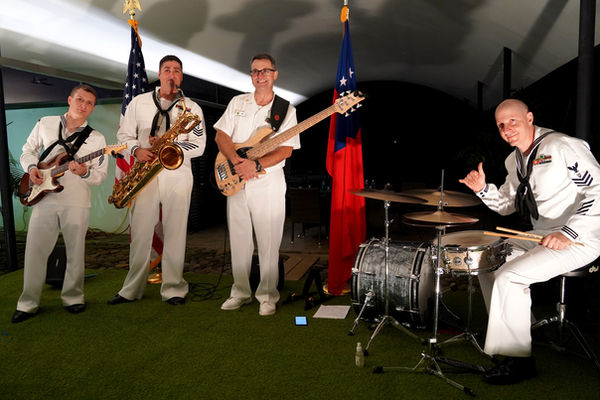
US Pacific Fleet Jazz Enemble at the residence of the US Charge d'Affaires
World Museum Day: Community Heritage in Action
On 18 May, Galumalemana Steven Percival presented at the International Museum Day programme hosted by the Ministry of Education and Culture under the theme “Museums Uniting a Divided World.” The presentation, “Ia so‘o le fau ma le fau: Community Heritage in Action,” explored how museums, community learning spaces, artisans, researchers, schools and cultural institutions can work together to safeguard Samoa’s living heritage.
As part of the occasion, Tiapapata Art Centre announced the gifting of a collection of contemporary heritage objects to the Museum of Samoa. The collection includes a fagufagu, to‘i fafau, pā-alo-atu, vilipā, selu lā‘au, ili lā‘au, ipu ‘ele, siapo and ‘afa-making tools, lama seeds, ‘afa and fau cordage, and the Upu ma Tala booklet.
The gift links museum collections with living practice. Rather than presenting cultural objects only as finished artefacts, the collection shows the tools, materials, processes, stories and skills through which Samoan knowledge is transmitted.
The Samoa Observer later featured the event under the headline “Museums key to reviving tradition: Galumalemana,” drawing attention to the role of museums and community heritage spaces in reviving, transmitting and interpreting cultural knowledge. Read more about the presentation and the published article here.

Galumalemana with students from Avele College on International Museum Day, 18 May 2026
Heritage, Media and Digital Documentation
Documentation remains central to Tiapapata’s work. The Centre continues to use film, photography, oral history, field trips, talanoa, and hands-on practice to support the safeguarding and transmission of Samoan cultural knowledge. This approach was highlighted in the World Museum Day presentation, which described TAC’s work in safeguarding living heritage, reviving cultural knowledge, and creating public learning opportunities.
The presentation also drew attention to the role of digital technologies in heritage safeguarding, including high-resolution photography, video documentation, 3D photogrammetry, 3D modelling and 3D printing. These tools can help record, study, interpret and share Samoan material culture for education, research, museum interpretation and access beyond Samoa.
One example is the revival of the fagufagu, the Samoan nose flute. The World Museum Day presentation connected archival records, contemporary making, artificial intelligence interpretation of historic musical notation, and future digital museum environments — showing how new technologies can help recover fragile traces of the past while supporting living practice today.
Plant Knowledge as Living Material Culture
A major focus for June is the upcoming Plant Knowledge Workshop at Tiapapata Art Centre on Saturday 13 June 2026, following related field visits on 11 and 12 June.
The workshop forms part of the University of St Andrews collaborative project Growing Climate Resilience and Regeneration through Intergenerational and Transnational Traditional Ecological Knowledge and Skills Exchange, involving partners in Samoa and Costa Rica. The project explores how traditional ecological knowledge, plant lore, community heritage and intergenerational learning can support climate resilience, biodiversity awareness, cultural continuity and regeneration.
The Samoa workshop is framed around plant knowledge as living material culture. It will explore the ways plants and trees are used in Samoan cultural practice, including fibre and cordage, siapo, natural dyes and pigments, artisanal paper, fale construction, tools, healing, food, ecological stewardship and cultural memory.
The programme brings together youth representatives, knowledge holders, artisans, educators, researchers, scientific and conservation organisations, and environmental agencies. It will combine field visits, practical demonstrations, youth reflection, panel discussion and informal talanoa.
The workshop will include youth groups, Professor Karen Brown and Dr Victoria McMillan from the University of St Andrews, Tiapapata Art Centre, the Samoa Conservation Society, SROS, MNRE, SPREP, Dr Iosefa Percival, and other invited contributors.
Field visits include the SROS Medicinal Garden, the MNRE Botanical Garden, Malololelei Reserve, and O le Pupu-Pu‘e National Park at Togitogiga. These visits will support discussion of medicinal plants, native flora, forest and mangrove ecosystems, plant uses, biodiversity, conservation, invasive species, and respectful documentation of knowledge.

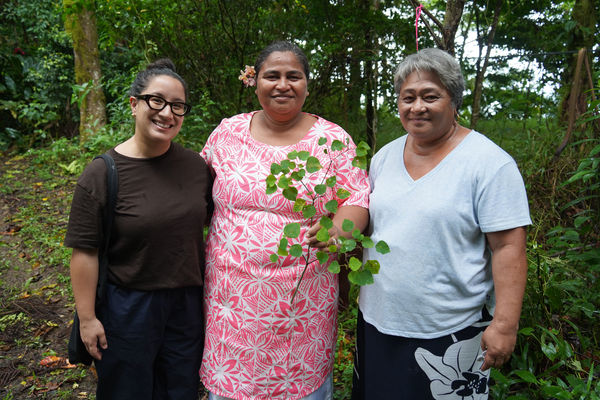
Neda Mei with traditional healers Purinisese Futi and Saumalu Teofilo
Taulasea, Conservation and Youth Learning
In early June, two taulasea, Saumalu Teofilo and Purinisese Futi, joined Galumalemana for a walk through the Malololelei Reserve, identifying trees marked in preparation for the workshop. They were accompanied by illustrator Neda Mei, who will assist in preparing educational resources for young participants.
Their participation brings an important traditional healing perspective to the programme. It also reminds us that plant knowledge is not only held in books, botanical gardens, or scientific records, but also in people — taulasea, tufuga, farmers, fishers, elders, women’s committees, families and communities.
The workshop also responds to urgent environmental concerns. Conservation advocates and residents have raised concerns about large-scale land clearing at Malololelei and the impact this may have on erosion, flooding, water systems, and native biodiversity. James Atherton of the Samoa Conservation Society has warned that exposed soil in upland catchments is at risk of erosion and that habitat and food resources for native biodiversity are being lost.
Dr Iosefa Percival will also contribute to the workshop on invasive species, helping young people understand how invasive plants can change forest ecosystems, outcompete native species, and reduce the availability of plants once used for medicine, food, craft, building and cultural practice.
At its heart, the workshop is about intergenerational transmission. It is not often that young people have the opportunity to walk through a forest, garden, reserve or national park with taulasea, conservationists, scientists, rangers, artists and other practitioners. This kind of accompanied field learning allows knowledge to be shared in context — beside the tree, beside the plant, beside the place where the knowledge belongs.
Film, Visitors and the Wider Creative Community
The Centre has also continued to serve as a space for visiting filmmakers, researchers and creative practitioners.
On 15 May, an umu was prepared and the film Reefshot was screened, with around 70 guests attending alongside filmmaker Matt Tomaszewski.
In May, Galumalemana also worked as a fixer for a film crew from Australia, Wild Pacific Media, supporting their work in Samoa.
On 22 May, Va, a musical concert with Matt Sephton, was held at the Centre. The music featured material recorded during Matt’s first residency at Tiapapata in 2025.
These activities show the continuing role of Tiapapata as a place where local and international artists, filmmakers, researchers, musicians and community members can meet, create and exchange ideas.
Looking Ahead
The coming months promise even more exchange, learning and creative work. The Plant Knowledge Workshop will open new conversations about ecology, culture, youth learning and climate resilience. The ongoing pottery, paper-making, fibre, music, museum and digital heritage work will continue to grow.
We look forward to welcoming more visitors, artists, researchers, students and community members to Tiapapata Art Centre.
As always, we remain guided by the idea:
Ia so‘o le fau ma le fau — binding knowledge, people, practice and place together.
Fa‘afetai tele lava to everyone who has contributed to the life of the Art Centre so far this year — artists, volunteers, knowledge holders, partners, families, youth, visitors, friends and supporters.
We look forward to seeing you at Tiapapata.
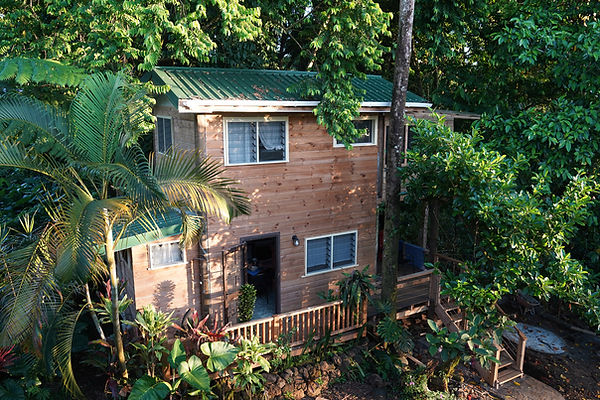
The "tall House" was completed in January 2026.
January 2026 Newsletter
Preserving Heritage & Creativity.
Happy New Year and warm greetings to our Creative Samoa community as we welcome 2026. We begin the year with gratitude — for the knowledge shared, the relationships strengthened, and the many hands and voices that continue to keep Samoa’s living heritage alive. We look forward to another year of creativity, learning, and meaningful cultural exchange.

Creative Art Classes at Tiapapata Art Centre
We are delighted to start the year with a special series of Creative Art Classes with visiting Creative Arts Therapist and practising artist Kerrie Reyntjes.


Upu ma Tala – Heritage Talanoa Series
Safeguarding Samoa’s Living Heritage
As we reflect on the closing months of 2025, we are proud to report on the successful completion of the Upu ma Tala – Heritage Talanoa Series, delivered by Tiapapata Art Centre with the support of UNESCO. The series takes its name from the Samoan proverb: “O tama a tagata e fafaga i upu ma tala, a’o tama a manu e fafaga i fuga o lāʻau”— reminding us that people are nourished by words, stories, and shared wisdom.Revitalising endangered knowledgeUpu ma Tala focused on cultural practices that are rarely taught today, yet remain central to Samoan identity. Across the series, knowledge holders and master practitioners shared skills and stories connected to:
-
fagufagu (nose flute)
-
pa-alo-atu (bonito composite lures)
-
siapo (bark cloth art)‘afa (cordage)
-
ipu ‘ele (pottery made from locally sourced clay)
-
va‘a carving and palolo fishing knowledge
These practices were explored not as museum artefacts, but as living traditions, shaped by environment, ancestry, and community.
Learning by doing:
True to fa‘a-Samoa, participants learned through hands-on
cultural apprenticeship — carving, shaping, weaving,
forming, and making alongside experienced practitioners.
This approach reaffirmed the importance of embodied
knowledge and intergenerational transmission.Inclusive
participationCommunity members, families, youth, and members of the Samoan diaspora all took part in the talanoa sessions and workshops. The series affirmed cultural participation as a shared human right and created welcoming spaces for dialogue, learning, and connection.
Documentation and legacy
Each session contributed to a growing archive of photographs, video recordings, and stories, forming valuable educational and cultural resources. These materials will support future teaching, exhibitions, outreach, and research, helping ensure the knowledge shared during Upu ma Tala continues to reach new audiences. Participants consistently reported:
-
strengthened cultural pride and identity
-
deeper family and community connections
-
renewed enthusiasm for safeguarding Samoan heritage.
Looking forward
The Upu ma Tala – Heritage Talanoa Series has laid strong foundations for:
-
sustainable cultural transmission
-
community empowerment
-
creative and cultural practice
-
protection of cultural rights
-
strengthened national identity.
Safeguarding living heritage ensures that future generations inherit not only stories about the past, but the skills, practices, and wisdom that continue to define Samoa.
Fa‘afetai tele lava!
We extend heartfelt thanks to all knowledge holders, practitioners, participants, partners, and supporters who contributed to Upu ma Tala. Your generosity, skill, and commitment have helped ensure Samoa’s living heritage continues to grow, adapt, and flourish.
We look forward to welcoming you to Tiapapata Art Centre in the year ahead — through creative art classes, future talanoa, and new opportunities to learn together.

Avenir Light is a clean and stylish font favored by designers. It's easy on the eyes and a great go-to font for titles, paragraphs & more.
